Project Hephaesas
Project Summary
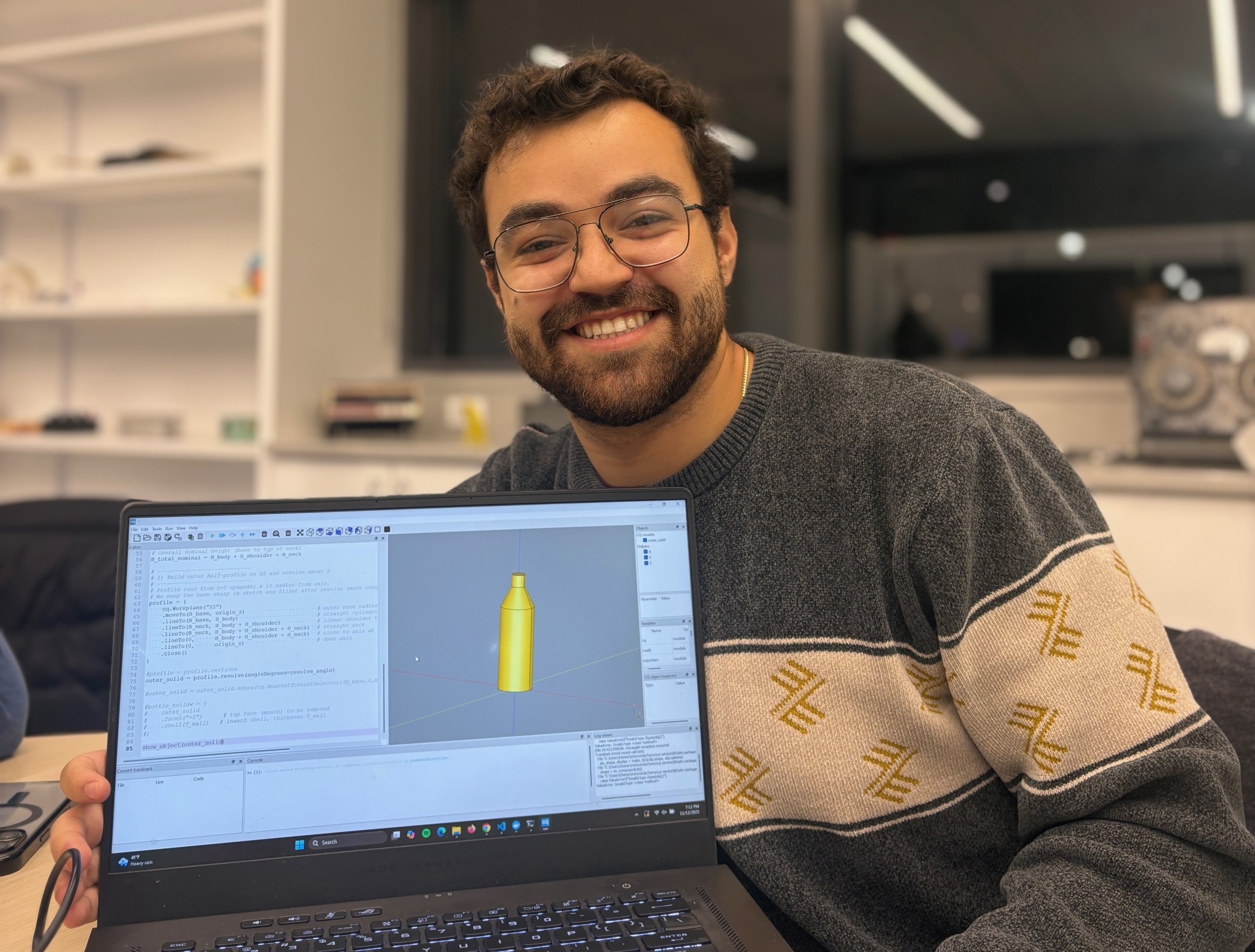
Project Hephaesas is a research initiative that addresses the critical bottleneck in modern product development: the time-consuming, manual nature of Computer-Aided Design (CAD) modeling. By leveraging large language models (LLMs) and multi-agent architectures, this project introduces an text-to-CAD workflow that translates natural language requirements into editable, parametric CAD models.
Across 30 test designs, the workflow demonstrated competitive performance with human CAD experts, achieving an average generation time of 7 minutes and 42 seconds, with 60% of designs accurately representing user intent and 50% producing fully editable parametric scripts alongside exportable geometry.
The Problem: CAD as an Iteration Bottleneck

Steep Learning Curve
CAD software requires specialized expertise and procedural knowledge. The interface-driven workflow demands mastery of discrete GUI operations (sketches, extrusions, fillets, patterns) that are powerful but time-consuming to execute and reproduce. As a result, design knowledge becomes "locked" in operator expertise rather than being systematically transferable.

Time Complexity
Modeling time scales proportionally with design complexity. Each iteration requires manual reconstruction of geometry, careful constraint management, and attention to downstream requirements like manufacturability. This makes CAD a pacing item for experimentation, especially early in development when designs change rapidly and the goal is exploration rather than finalization.

Implicit Design Intent
Traditional CAD workflows capture "how" a model was built rather than "what" requirements it satisfies. Design intent is often implicit in modeling choices rather than explicitly represented as a reusable specification. This makes it difficult to systematically modify designs in response to changing requirements or to validate that a model meets its functional goals.

Limited Automation
Despite advances in simulation and digital manufacturing, CAD modeling itself remains highly manual. Parametric capabilities exist but require upfront planning and technical sophistication. There's a fundamental gap between high-level design intent and low-level geometric operations that current tools don't bridge effectively.
The Solution: AI-Workflow for CAD
Project Hephaesas addresses these challenges by shifting from "click-to-build" to "intent-to-build" CAD. Rather than relying on manual modeling or simple prompt-to-model generation, the system uses a sophisticated pipeline that decomposes the translation from natural language to parametric geometry into distinct, verifiable stages. This architecture emphasizes AI-human collaboration, where AI handles procedural overhead while preserving human oversight and editability.
AI-Human Collaboration Design Philosophy
Rather than attempting full automation, Project Hephaesas is architected around augmentation. The collaboration model acknowledges that AI excels at pattern matching and procedural execution but still requires human oversight for ambiguity resolution, functional validation, and design optimization. Engineers review and refine AI-generated designs rather than building models from scratch, shifting their time toward design evaluation and decision-making where engineering judgment creates value.
Intelligent Multi-Stage Processing
The workflow processes design requests through specialized AI stages, each focused on a specific aspect of the modeling process. By breaking down the complex task of CAD generation into these stages, the system can handle ambiguity more effectively, recover from errors more gracefully, and produce outputs that are geometrically correct. This separation of concerns improves reliability and creates clear checkpoints for quality assurance.
Editable Parametric Outputs
Unlike black-box generative approaches, Project Hephaesas produces two key artifacts: (1) an editable script with explicit variable definitions, enabling rapid regeneration and parameter-driven edits, and (2) neutral-format geometry exports (STEP files) for interoperability with downstream tools. This dual-artifact approach preserves the benefits of parametric CAD while enabling seamless integration into existing workflows.
B-Rep Modeling for CAD Compatibility
The system uses Boundary Representation (B-Rep) modeling, which represents 3D objects as collections of surfaces, edges, and vertices. This approach is fundamentally different from mesh-based 3D modeling used in entertainment and is specifically designed for engineering and manufacturing applications.
B-Rep maintains exact mathematical definitions of surfaces rather than approximations, enabling precise dimensional control and downstream manufacturing operations. As an industry standard, this makes the generated models directly compatible with industry-standard CAD software and manufacturing processes including CNC machining, injection molding, and additive manufacturing.
Applications & Use Cases
Project Hephaesas opens new possibilities for how engineering teams approach design. By reducing the friction between concept and model, the system enables use cases that are impractical with traditional CAD methods:
Quick Prototyping
Generate parametric "rough drafts" in minutes rather than hours and accelerate early-stage ideation. The workflow's time-to-first-artifact performance (6-10 minutes) is competitive with skilled human modeling for simple parts, making it viable for rapid concept validation. This speed advantage compounds in iteration-heavy projects where multiple design candidates must be evaluated quickly.
Parallel Design Assessment
Generate multiple solution candidates simultaneously for comparative evaluation. The multi-agent architecture's near-constant runtime means that five design variations can be produced almost simultaneously. This enables parallel exploration strategies where teams can evaluate competing approaches side-by-side, assess trade-offs in real-time, and make informed decisions based on comparative analysis rather than sequential iteration.
Requirement-Based Designing
Shift from implementation-focused modeling to constraint-satisfaction workflows. Rather than specifying how to build a model through procedural steps, designers articulate what requirements (like dimensional constraints) must be satisfied.
These applications suggest a broader implication: as AI handles procedural overhead, engineering work shifts toward higher-leverage activities. The value proposition isn't eliminating human involvement but reallocating effort to where it creates the most impact.
Explore the CAD models generated by Project Hephaesas. These parametric designs were created from natural language prompts, demonstrating the system's ability to translate intent into editable, manufacturable geometry. Use the controls below to view different models.
Controls: Left-click and drag to rotate • Right-click and drag to pan • Scroll to zoom
Preliminary Results & Performance Metrics
Across 30 test designs evaluated between August 2025 and December 2025, Project Hephaesas demonstrated proof-of-concept viability for LLM-driven CAD automation. Performance was assessed across three dimensions: speed, completion rate, and intent-fidelity accuracy.
Speed: Competitive with Human Modeling
Average end-to-end runtime from natural language prompt to deliverable artifacts was 7 minutes and 42 seconds. Variance across all designs was approximately 34 seconds, indicating consistent performance regardless of geometric complexity.
This performance is competitive with skilled human modeling for simple parts. Industry CAD challenges like Model Mania report typical completion times of 30-45 minutes for full modeling attempts, with elite performance in the single-digit minutes range. The workflow's near-constant runtime suggests strong potential for large-scale, iteration-heavy projects where human modeling time scales with feature count and design complexity.
Completion Rate: 50% Full Parametric Artifacts
The workflow achieved 15/30 (50%) fully completed runs, defined as producing both exportable geometry (STEP files) and executable parametric scripts. The remaining 15/30 (50%) yielded geometry-only outputs, where final solids were exported but scripts required manual refinement.
Accuracy: 60% Intent-Faithful Designs
Manual intent-fidelity scoring categorized designs as: 18/30 (60%) accurate representations of the original prompt, 9/30 (30%) partially accurate but capturing core design intent, and 3/30 (10%)requiring significant revision.
The high proportion of accurate and partially accurate designs (90% combined) demonstrates that the system reliably captures and translates user intent into functional CAD models. The partially accurate category represents designs that successfully implemented the fundamental geometry but may have benefited from additional clarification or refinement.