IoT Plant Monitoring System
An Internet of Things educational framework designed to enhance STEM learning through hands-on environmental science and sensor technology integration at Geneva High School.
Summary
This project applies hardware design principles, sensor selection and deployment, and wireless communication to develop an Internet of Things (IoT) Plant Monitoring Enclosure aimed at enhancing STEM education and generating positive societal impact. The primary function of the system is to monitor and analyze plant growth conditions using a sensor-integrated IoT framework.
The enclosure features two core components a transparent plant chamber for environmental observation and a water compartment for soil moisture management. Sensors track soil moisture, humidity, temperature, and plant height, with data transmitted wirelessly via LoRaWAN and visualized through a remote dashboard.
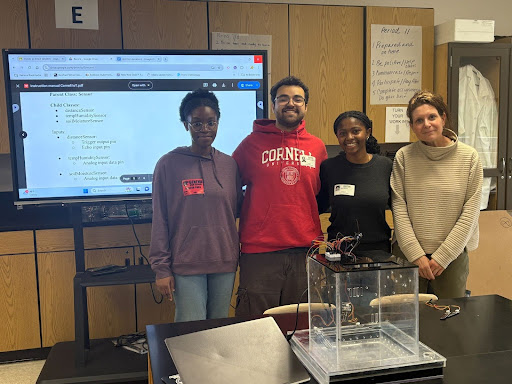
This design was developed in collaboration with Geneva High School, working closely with community partners Kirsten Abbott (former AP Environmental Science teacher) and Shelley Walker (botany teacher) to align the system with classroom goals and student interests. The final prototype was deployed in Ms. Walker's classroom, where students use it alongside their environmental botany curriculum.
Social Context & Educational Impact
The Growing Importance of IoT
As of 2023, there are 16.6 billion IoT-connected devices worldwide, projected to reach 18 billion by the end of 2025. IoT has seamlessly integrated into our phones, homes, cars, and education systems. Throughout our daily lives, we interact with IoT devices, often without fully understanding the technology that powers them.
Addressing Educational Barriers
While "smart education" through technology like Zoom and Google Meet has increased accessibility during the COVID era, barriers still exist. Rural areas often lack access to broadband internet, creating challenges for digital literacy and STEM exposure, specifically in the technological field. Students in these areas face particular difficulties in understanding the IoT systems that increasingly shape our world.
Our Educational Approach
We feel it is incredibly important to engage with students in a way that helps them better understand the world that surrounds them while building upon knowledge they already possess. Our approach creates a fun, plant-growing activity that engages students and allows them to apply their environmental science skills differently.
Students observe plant growth while collecting data from temperature, moisture, and distance sensors in an enclosure we designed. This data allows students to detect when a plant needs watering or when enclosure temperature should be altered based on sensor readings. Through this process, students gain familiarity with basic circuits and hardware that are used in IoT systems.
The project was developed in collaboration with Geneva High School teachers Kirsten Abbott and Shelley Walker to align with classroom goals and environmental botany curriculum.
Our project is unique because it gives students the opportunity to interact with STEM principles within the classroom as opposed to outside of it in elective clubs. It is incredibly important that students are allowed to have hands-on experience with STEM in their classrooms, especially for those who are not sure if it's even an interest to them.
Broader Impact: Beyond this implementation, the project is intended to serve as a framework for broader use of sensor-based technologies in STEM education. The complementary instructional manual we've created, along with the IoT Plant Monitoring Enclosure, provides a replicable model that can be adapted to other subject areas to promote experiential, technology-enhanced learning across different educational settings.
Our Solution: Enclosure Design & Sensor Integration
Design Philosophy
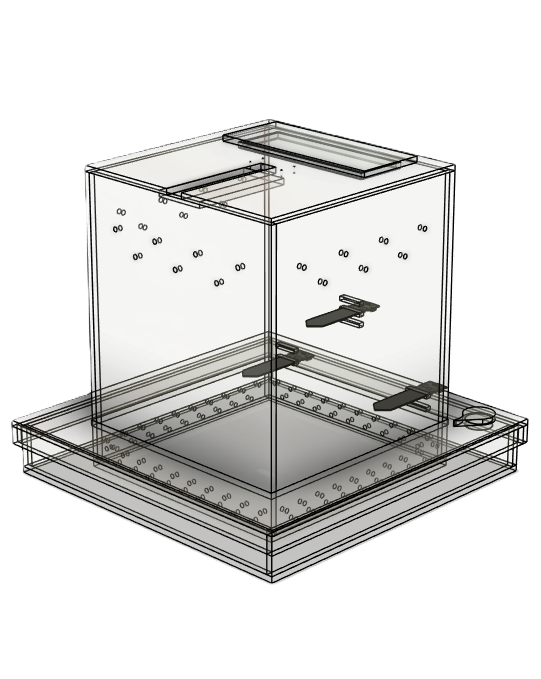
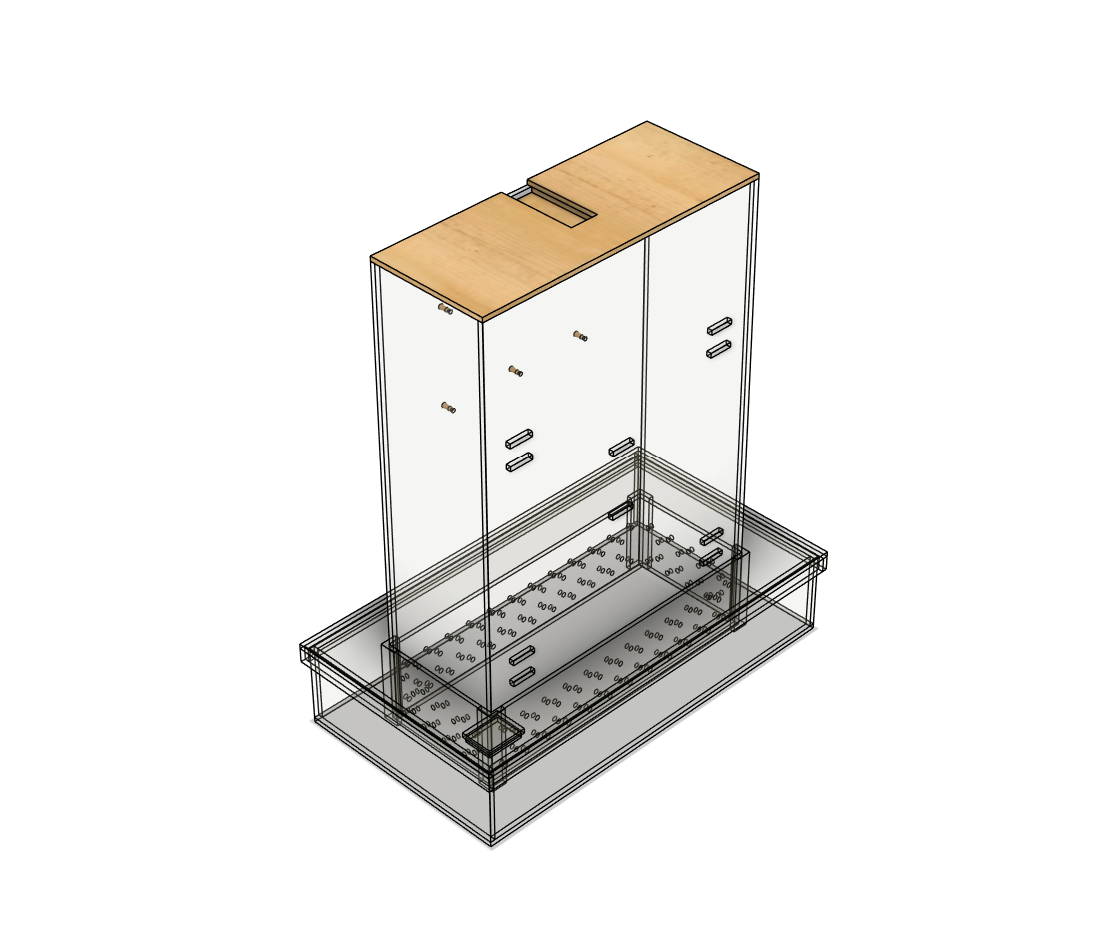
The enclosure was designed with three key principles in mind: easy assembly for students, comprehensive sensor integration, and protection against water damage. The modular design allows students to understand how each component contributes to the overall system while maintaining accessibility for maintenance and observation.
Plant Enclosure: Growth Environment & Sensor Access
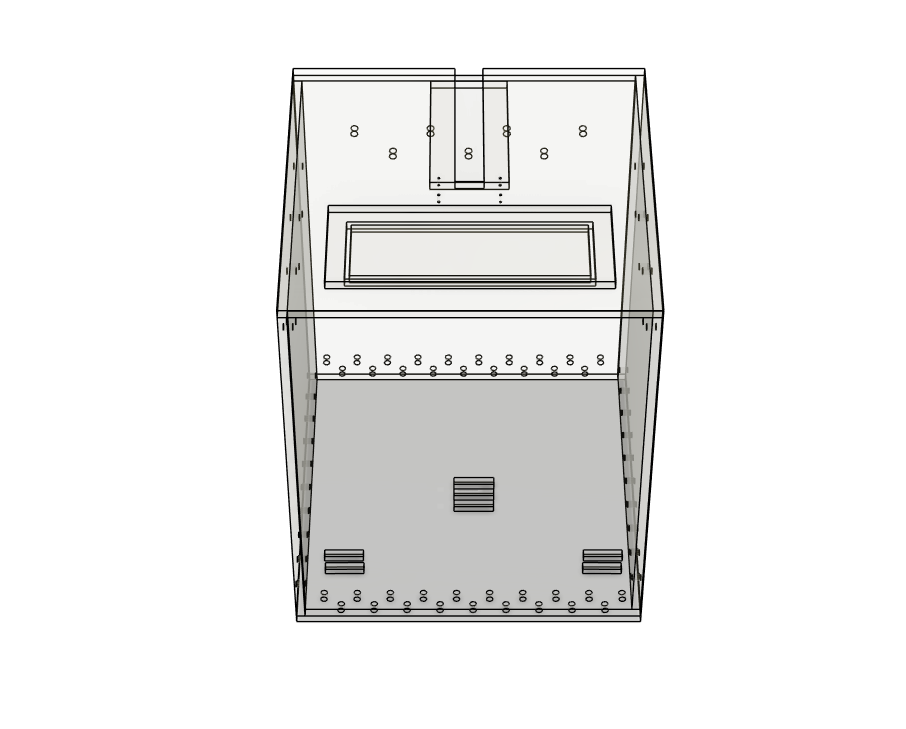
The plant enclosure features two key design elements that work together to create an optimal growing environment while enabling comprehensive data collection:
Reverse Watering System
Rows of small holes at the base utilize capillary action to water the soil from the bottom, protecting top-mounted sensors from water damage while ensuring consistent soil moisture distribution.
Humidity/Temperature Sensor Ports
Back panel features multiple holes for placement of sensor wires. Unused ports are sealed with corks, maintaining environmental control while allowing flexible sensor positioning.
The transparent acrylic construction enables students to observe root development and soil moisture levels visually, connecting their digital sensor readings with physical observations. This dual-mode observation reinforces the relationship between abstract data and concrete biological processes.
Water Compartment: Foundation & Safety
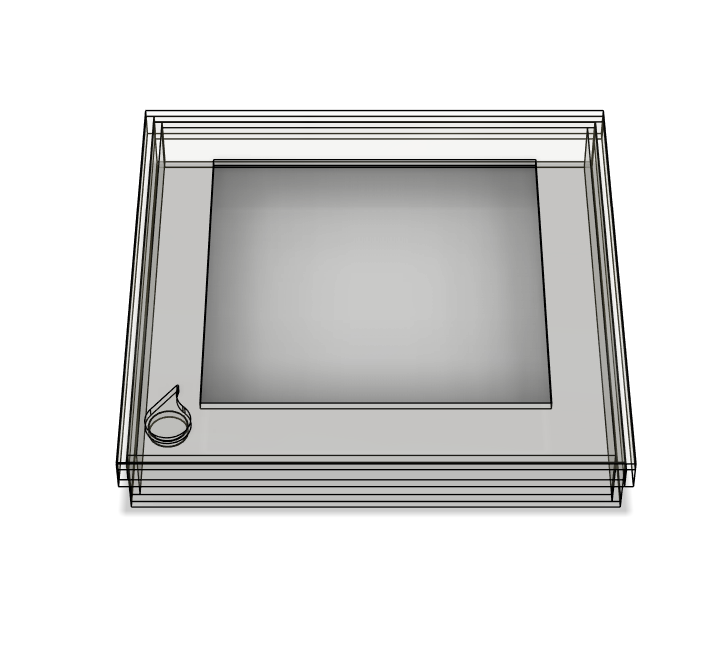
The water box serves as the structural foundation and a critical safety component of the design. Constructed from transparent acrylic, it allows students to monitor water levels visually without opening the system. The removable lid features a dedicated water inlet to prevent splashing and protect electrical components during refilling.
Sensor Selection & Integration
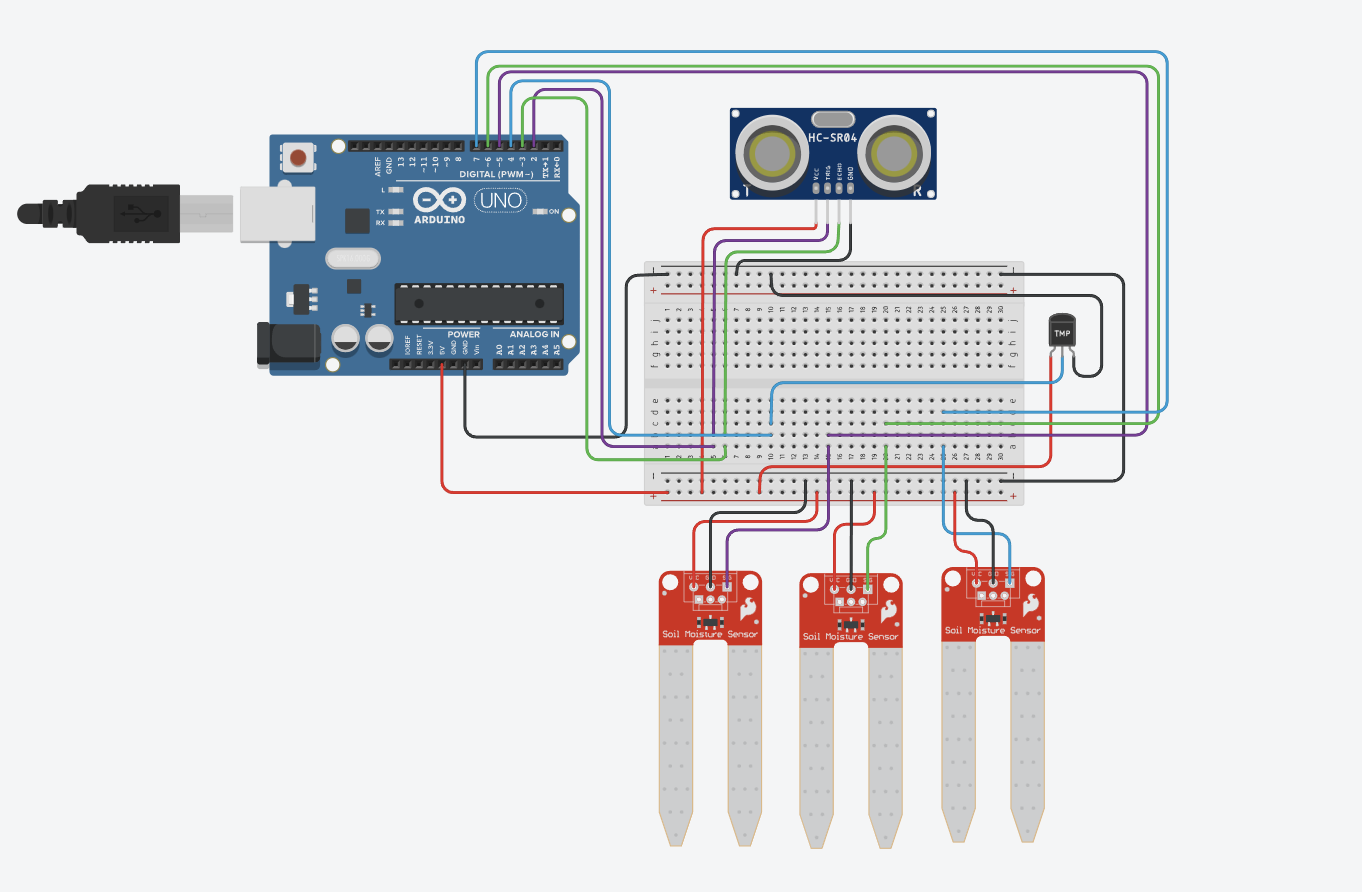
The system consists of three soil moisture sensors, one temperature and humidity sensor, and an ultrasonic distance sensor. These sensors were chosen based on learning objectives and the potential for expanding analysis in future iterations. Each sensor provides critical data about different aspects of plant health and growth conditions.
Soil Moisture Sensor
Capacitive sensors that detect water content in soil using dielectric theory. These sensors provide analog data readings representing moisture levels.
Specs: 3.3V/5V, Hourly readings, 3 sensors for comprehensive monitoring
Temperature & Humidity Sensor
Digital sensor that returns both temperature and humidity information crucial for ensuring proper living conditions.
Specs: 0-50°C range, ±2°C accuracy, 15-minute intervals
Ultrasonic Distance Sensor
Four-pin sensor that measures plant height using ultrasonic waves. The trigger sends out the wave, and the echo pin relates the speed of sound to distance, calculating plant growth over time.
Specs: 2cm-400cm range, 0.3cm resolution, Daily readings
Power Considerations: All sensors operate within the voltage ranges provided by the Adafruit Featherboard (3.3V and 5V), simplifying the power distribution system. The staggered data collection schedule optimizes power consumption while capturing meaningful changes in plant conditions.
System Implementation & Deployment
Wireless Communication Architecture
The system uses LoRaWAN (Long Range Wide Area Network) to transmit sensor data wirelessly to The Things Network (TTN), enabling internet connectivity without WiFi. This technology choice allows deployment in locations with limited network infrastructure while teaching students about modern IoT communication protocols.
LoRaWAN operates by sending data from the Featherboard to a nearby gateway, which then forwards the information to TTN servers via the internet. The botany teacher, Ms. Walker, can access the plant data from anywhere using their TTN account credentials.
Software Architecture & Code Structure
The code makes extensive use of object-oriented programming with classes and methods, simplifying the implementation enough that students with little or no coding experience can follow the general logic. This approach abstracts complex sensor operations behind simple method calls while still exposing the underlying structure for learning purposes.
Parent Class: Sensor
Contains global attributes and functions like initializing sensors and identifying sensor types. Provides a common interface for all sensor operations.
Child Classes
Each sensor type (distance, temperature/humidity, soil moisture) has its own class with specific data reading methods tailored to that sensor's characteristics.
TTN Data Class
Packages sensor data into a format suitable for LoRaWAN transmission. Handles the complexity of radio communication behind simple method calls.
Field Deployment at Geneva High School
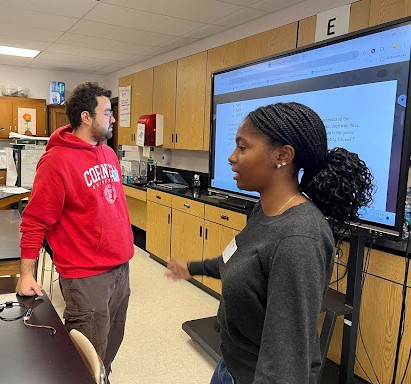
The system was presented to Geneva High School students on May 9, 2025, with a comprehensive 40-minute hands-on session. Students received physical copies of the instruction manual and participated in connecting the sensors to the Featherboard and enclosure. The team demonstrated the working principles of sensors, Arduino programming, breadboard connections, and circuit diagrams.
Instruction Manual & Educational Materials
The comprehensive instruction manual created for this project serves as both a technical reference and an educational tool. It covers fundamental IoT concepts, Arduino programming basics, sensor operation principles, circuit design, and TTN integration. The manual is designed to be accessible to students with varying levels of technical experience, using clear explanations and visual diagrams.
Key sections include an introduction to the Internet of Things explaining how devices collect and exchange data over the internet, Arduino hardware and software fundamentals, breadboard usage and electrical circuit concepts (including Ohm's Law, parallel and series connections), detailed sensor explanations for each type used in the project, code structure and class-based programming concepts, and TTN integration for wireless data transmission.
Project Files & Documentation
Access the complete project documentation, code, and design files below.
Files may take a few seconds to load depending on size.